
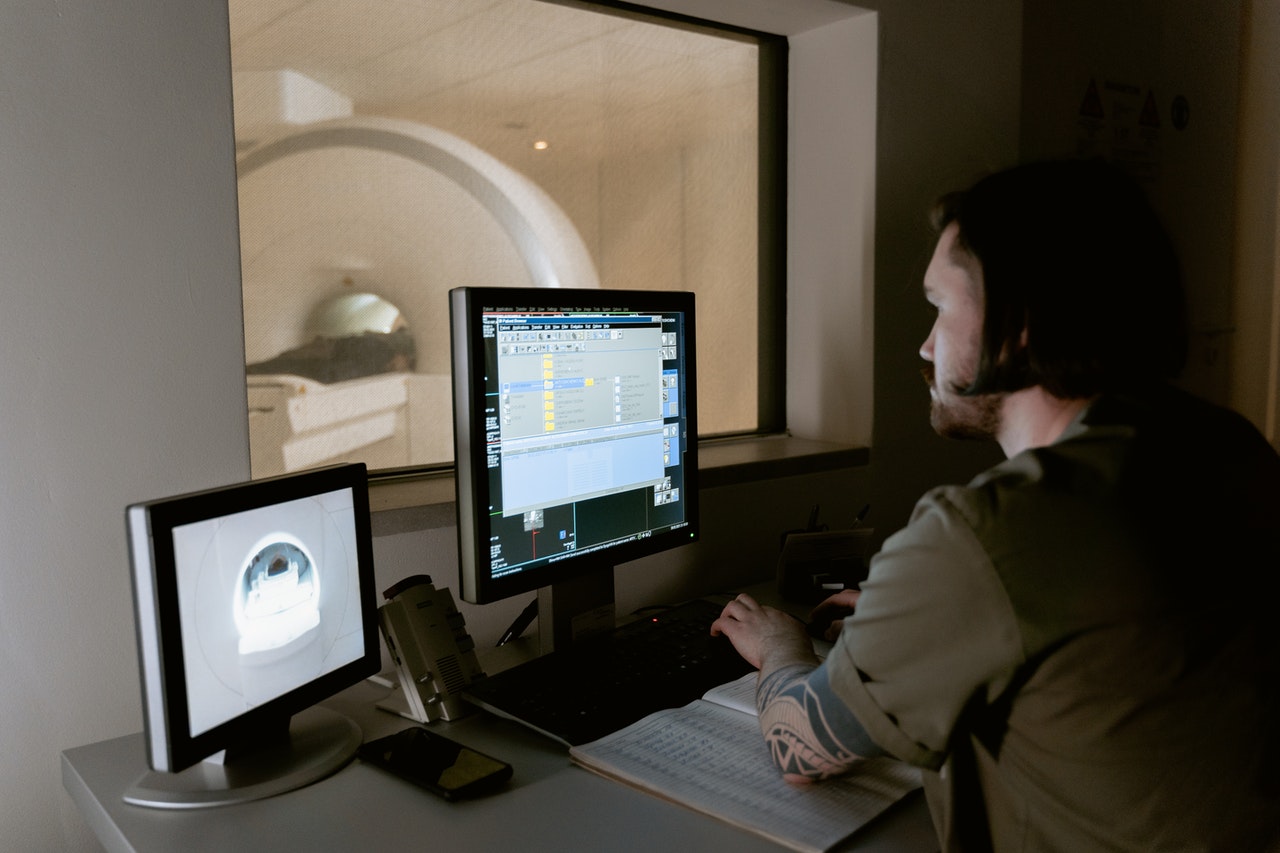
With approximately 250,000 new cases per year, prostate cancer is the second-most common malignancy affecting men. Effective treatment requires not only diagnosing cancer but assessing how likely it is to spread. MRI machines for prostate cancer offer improvements over traditional diagnostic methods.
What Are the Limitations of Traditional Prostate Cancer Diagnostics?
Traditionally, a prostate cancer diagnosis is a two-step process. It starts with a blood test to screen for prostate-specific antigen. If the PSA level is elevated, a transrectal ultrasound-guided biopsy is performed to confirm the diagnosis. These diagnostics are reasonably effective at identifying prostate cancer but are not infallible. There are parts of the prostate that an ultrasound-guided biopsy cannot reach. Thus, the test may either miss cancerous tumors in these areas altogether or not collect enough tissue to make an accurate diagnosis.
While standard screening methods work fairly well at identifying that prostate cancer is present, they are less effective at determining how clinically significant it is. Prostate cancer can range in severity. High-grade tumors are aggressive and likely to spread. Low-grade tumors grow slowly and have little metastatic potential.
High-grade tumors pose a greater risk to the patient’s life and so require aggressive treatment. However, low-grade tumors pose less of a threat because they are unlikely to spread. Therefore, they do not require the same treatment course as high-grade tumors. Eventually, they may benefit from operative treatment or radiation therapy, but they do not require immediate intervention.
Nevertheless, because the ability of traditional diagnostic methods to assess the risk to the patient is limited, many prostate cancer patients are overtreated and may suffer adverse outcomes as a result. On the other hand, the patient can also suffer consequences from misdiagnosis of high-grade prostate cancer that delays treatment.
What Roles Can MRI Play in Prostate Cancer Diagnosis and Management?

MRI has been used in the diagnosis of prostate cancer since 1982.
Since that time, it has had an increasingly significant role to play not only in prostate cancer diagnosis but through the course of treatment:
- Diagnosis: MRI can not only confirm the presence of prostate cancer but pinpoint its location.
- Staging: An MRI can determine whether prostate cancer has metastasized, i.e., spread to other parts of the body. This indicates how serious the malignancy is and helps with preoperative planning.
- Risk Stratification: An MRI can determine how likely the cancer is to spread, which informs the treatment course that the doctor may recommend.
With low-grade prostate cancer that is unlikely to spread quickly, doctors often recommend conservative treatment,
such as active surveillance, rather than immediate intervention. In other words, the patient returns to the doctor on a regular basis for repeat evaluation. If there is any change in the patient’s condition or progression of the disease, treatment can then take place. MRI is a valuable tool in active surveillance because it allows doctors to visualize the prostate and identify any changes quickly.
How Accurate Is MRI in Diagnosing Prostate Cancer?
MRI is very accurate in diagnosing prostate cancer because of its ability to exceed the limitations of traditional diagnostic methods. Because of the standardized prostate imaging reporting and data system, MRI is also very accurate at determining the clinical significance of suspicious nodules found in the prostate.
The PI-RADS system uses a five-point scale to determine the likelihood that prostate lesions are cancerous:
- PI-RADS 5: Clinically significant cancer is highly likely
- PI-RADS 4: Clinically significant cancer is likely
- PI-RADS 3: Equivocal chances of clinically significant cancer present
- PI-RADS 2: Clinically significant cancer is unlikely
- PI-RADS 1: Clinically significant cancer is highly unlikely
PI-RADS also allows doctors to pinpoint the location of lesions by providing a sector map of the prostate and standardizes terminology to be used for reporting. Additionally, it also sets protocols for image acquisition and interpretation and technical standards for hardware, all of which helps to make MRI more accurate in diagnosing prostate cancer.
An MRI examination of the prostate typically consists of three individual imaging sequences, one with contrast and two without. This multiparametric imaging technique helps improve the accuracy of the results.
What Other Factors Affect Prostate MRI Accuracy?
The strength of the magnet field used in MRI scanning is measured in units called Teslas. The higher the Tesla amount, the stronger the magnetic field. In 1982, when MRI was first used for prostate examination, the strongest magnets available were only 0.08 T. Today’s MRIs use stronger magnets measuring between 1.5 to 3 T.
The minimum field strength recommended for prostate imaging is 1.5 T, but 3 T is considered optimal. Higher resolution images are produced with increased field strength, and the imaging takes place more quickly as well. Patient behavior also has an important role to play in the accuracy of a prostate MRI.
Prior to the scan, the patient receives instructions to remain as still as possible. Movement of the body during the scan can cause a blurring of the image known as a motion artifact. If the artifact affects the ability to read the image, it may be necessary to take the image again.
What Are the Benefits of Prostate MRI?

Because of the accuracy of prostate MRI of not only diagnosing cancer but identifying the risk, it helps improve the prognosis for people with high-grade malignancy by indicating immediate intervention. It also benefits patients with low-grade prostate cancer by delaying radical intervention, e.g., radiation therapy or surgery, until it is warranted.
This avoids exposing patients unnecessarily to the risks inherent in these more aggressive treatment options.
Another significant benefit of prostate MRI is that it is much less invasive than other diagnostic methods, particularly ultrasound-guided biopsy. Prostate MRI can narrow down possible biopsy collection sites or even eliminate the need for biopsy altogether.
What Is the Prognosis for Prostate Cancer?
Out of every 33 patients diagnosed with prostate cancer, only one will eventually die of it. The less aggressive the malignancy, the better the prognosis. Prostate MRI helps to improve the prognosis by identifying the risks to the patient from cancer versus the treatment. Brooklyn Open MRI is an MRI center in Brooklyn, NY. Schedule an appointment at +1 (718) 400-6369.