

Magnetic Resonance Imaging (MRI) is a medical diagnostic imaging procedure that can, among other uses, help diagnose Multiple Sclerosis (MS). Since MS affects tiny nerve cells deep within the body, doctors must see these areas clearly when confirming the MS diagnosis and monitoring the disease’s progression. Doctors can quickly identify MS on MRI scans.
What is Multiple Sclerosis?

Multiple Sclerosis is a neurological disease affecting the brain and spinal cord. Although the cause of MS is unknown, researchers believe genetics and environment could be involved.
MS develops when the body’s immune system responds abnormally. Instead of protecting the body, the immune system attacks the central nervous system. The fatty sheets that cover nerve fibers are called myelin. MS causes the myelin to break down and form scar tissue or lesions. As a result of the scarring and damage on nerve fibers, the brain’s messaging system can’t function properly. There are different treatments for MS, including brain surgery, depending on the type and severity.
What is Magnetic Resonance Imaging?

Magnetic Resonance Imaging is a non-invasive imaging method widely used to diagnose many conditions. Doctors can use an MRI machine to determine whether an injury or illness affects soft tissue or organs in the body. If you have a condition affecting muscles, tendons, ligaments, the brain, nerves, or spinal cord, your doctor could recommend an MRI imaging appointment for diagnosis.
How Does MRI Work?
MRI machines feature a large, powerful magnet to produce an intense magnetic field. The magnetic field affects the orientation of particles inside organs and tissues in the body, causing them to line up in a specific direction. Once the magnet has aligned these particles, a computer sends radio waves into the magnetic field. When the radio waves reach the aligned particles, the resulting interaction is recorded on special sensors. Then the computer takes these signals and turns them into images.
For example, if an MRI is scanning the brain, the computer will produce multiple brain pictures in sections similar to slices. It is this multiple-slice feature that allows doctors to see inside the entire brain.
What Should I Expect At My MRI?
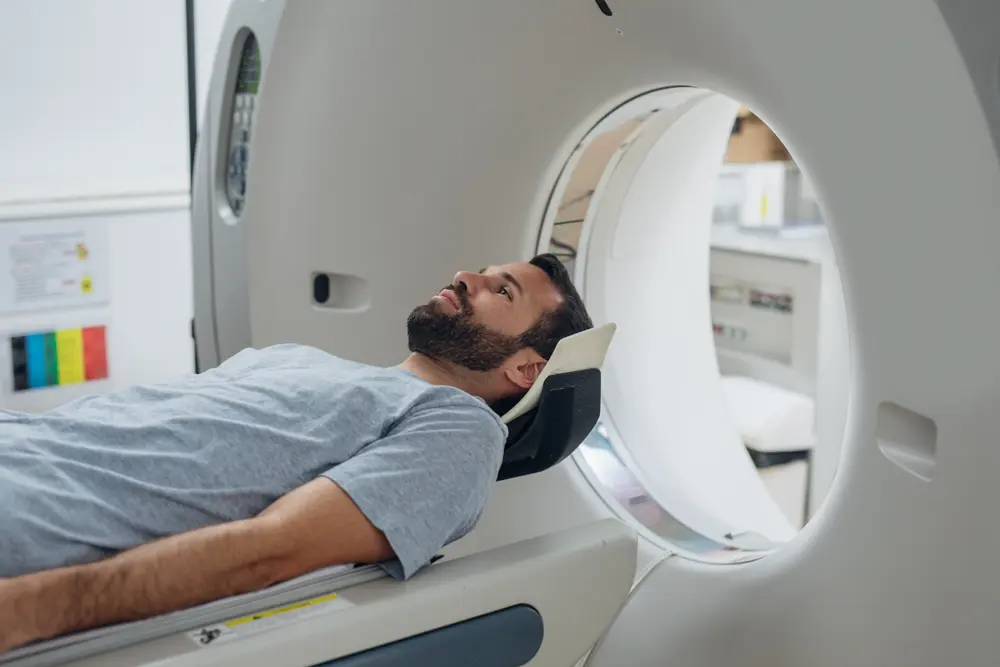
For an enclosed MRI exam, you will see a tunnel or tube-shaped machine with a bed in the middle. During the scan, you lie on the bed, and it slides back into the machine. Although the technician will give you earbuds to deaden the sound, you might still hear some knocking and banging noises as the device is scanning. Most tunnel MRI scans last between 15 and 45 minutes.
Instead of a tunnel, an open MRI is similar to a sandwich. Patients lie down in the space between two flat, donut-shaped magnets for open MRIs. The magnets and scanners are on the top and bottom, with the patient in the middle. This design allows the patient plenty of space and a clear view of the room.
How Can an MRI Help To Diagnose MS?
To accurately diagnose multiple sclerosis, MRI scans should be included during testing. Your doctor will use MRI image results to:
- Confirm suspected MS
- Evaluate to rule out other diagnoses
- Have a baseline record of images to monitor the progression of MS
According to Medical News Today, over 90% of MS diagnoses are confirmed by MRI.
Why Is the First MRI Important After an MS Diagnosis?

MS is unpredictable because the nerve damage can become progressively worse, stay the same, or go into remission. For this reason, doctors must have clear images of MS-related lesions when patients are initially diagnosed. Those first images are a baseline, which will allow doctors to make comparisons with other scanned images in the future. When comparing the two scans, they will quickly discover if there is more scarring and where it is occurring. The comparison helps to track the course of the disease.
How Often Are Monitoring MRIs Scheduled for MS?
Repeat MRIs could take place every 3 to 12 months depending on:
- When the patient was diagnosed
- If the patient has additional medical problems
- Which treatments does the patient currently receive
What Are Doctors Looking For on Multiple Sclerosis MRI Images?

MRIs are ideal for diagnosing and monitoring MS because the scanned images can capture water-filled tissues deep within the body. Because myelin is made of fatty tissue, it repels water. The myelin damage will show up on the MRI as white or dark spots, indicating that water has taken the place of myelin.
For multiple sclerosis, MRI spine and brain images will show lesions. Doctors will look over the detailed pictures produced by MRI scanning for new lesions, the locations of the new lesions, and the extent of the damage. MRIs will also determine the progression of MS:
- Is MS stable?
- Is MS active but not worsening?
- Is there no evidence of activity?
- Is there a relapse? (new lesion growth after a long period of no damage)
Experience Open MRIs at Brooklyn Open MRI
At Brooklyn Open MRI, you still have all the benefits and advantages of traditional, enclosed MRI scans. The design of our open MRI machines allows you to relax and see everything going on around you. This is particularly helpful if you experience claustrophobia (fear of being trapped in tight spaces). Our open MRIs are more comfortable for patients who are obese or have movement difficulties due to injuries. Children may also feel better in an open MRI since they can see their parents and hold their hands.
Patients experience additional benefits of open MRI scans:
- MRIs are painless and non-invasive.
- There is no radiation exposure.
- You can immediately return to normal activities.
Before you arrive at our office in Brooklyn, you can eat and drink as normal. You may want to wear loose-fitting clothes to keep comfortable. However, you will need to remove anything metal, including jewelry and belts with metal buckles. You must tell the MRI technician if you have any metal in your body, such as a pacemaker or joint replacement. MRIs are not recommended for pregnant women.
Contact Us
Contact us online or call us today at (718) 400-6369. We are located at 3506 Nostrand Avenue, Brooklyn, NY 11229, between avenues U and V. We accept most health insurance plans. Same-day appointments may be available.